
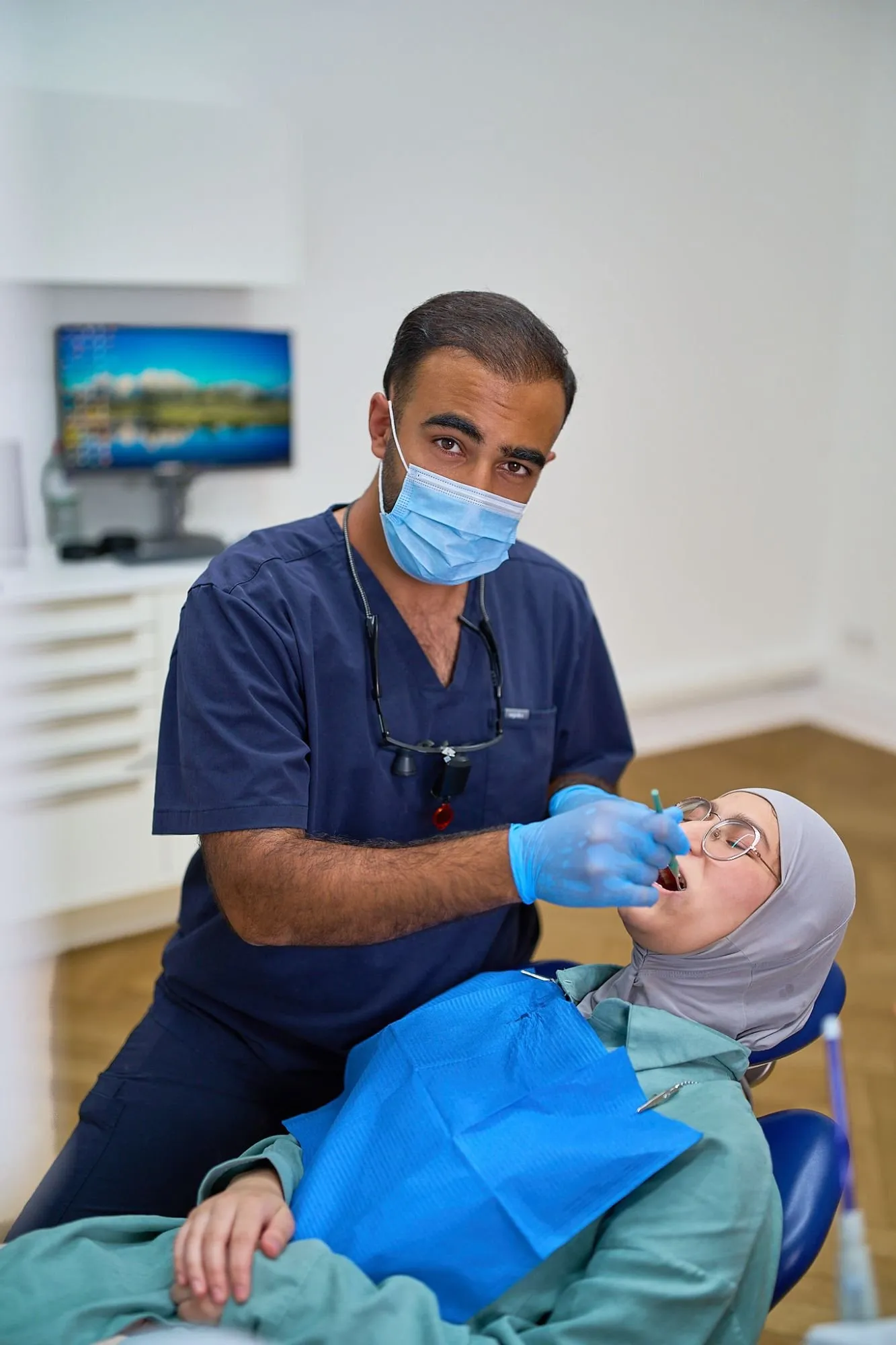
About this treatment
Inflammation of the dental pulp (the ‘nerve’ of the tooth) can be caused, for example, by bacteria getting into the tooth, and it usually shows itself as pain.
Root canal treatment is then needed to save the tooth. It calls for precision and care – with the aim of keeping your own tooth.
Who it may suit
Root canal treatment may be needed if the pulp is inflamed or has died – for example because of deep decay, a cracked tooth or an injury. Signs can include pain when chewing, lingering sensitivity to hot or cold, or swelling. Sometimes the inflammation causes no symptoms and only shows up on an X-ray.
At a glance
- Usually caused by bacterial inflammation of the pulp
- Precise root canal treatment
- Aim: to save your own tooth
Related treatments
If a tooth cannot be saved, an implant can close the gap.
ImplantsRegular check-ups and professional cleaning help to detect tooth decay early.
Preventive care
The technology behind this treatment.
- 01
Dental microscope
We carry out root canal treatment under a dental microscope. Magnification and light make the fine structures inside the root canal visible.
- 02
CBCT if needed
If the course of the root canals is not clear on a standard X-ray, a 3D CBCT scan can provide additional information.
How treatment works. Step by step.
These are the usual steps. What you need depends on our findings, and we will discuss it with you beforehand.
Step 1: Examination and X-ray
We examine the tooth and take an X-ray. If the course of the canals is not clear, a CBCT scan can provide additional information.
Step 2: Cleaning the canals
Under local anaesthetic, we open the tooth, remove the inflamed tissue and clean the root canals under the dental microscope.
Step 3: Filling and sealing
The cleaned canals are filled tightly and the tooth is sealed. Depending on the findings, this takes one or more appointments.
Step 4: Restoration and check-ups
The tooth is then restored, often with a crown. Follow-up X-rays show us how the tissue around the root tip is developing.
Your questions, briefly answered.
- Does root canal treatment hurt?
- Treatment is usually carried out under local anaesthetic. The tooth may feel sensitive for a few days afterwards, especially when chewing.
- What is the dental microscope for?
- Root canals are very fine and sometimes branched. The microscope’s magnification and light reveal structures that are barely visible to the naked eye.
- What is the alternative to root canal treatment?
- The alternative is usually to take the tooth out. The gap is then generally closed with a bridge or an implant. After the examination, we will assess whether your tooth can be saved.
- Will my health insurance pay?
- Statutory health insurers cover root canal treatment if, under their guidelines, the tooth is considered worth saving. Additional services may have to be paid for privately. We will let you know beforehand what costs to expect.
Send us a message.
Questions about treatment, costs or appointments? Send us a message and we will get back to you as soon as possible.