
About this treatment
Missing teeth do not just make it harder to bite – they also make a relaxed smile almost impossible. In these cases, implants are one possible solution: artificial tooth roots are anchored in the jawbone and support new teeth.
The artificial tooth roots are made of titanium or ceramic. Even where there is little jawbone, bone grafting is possible in many cases; we will look at this with you at your consultation.
Who it may suit
Implants may be an option if you are missing one tooth, several teeth or all the teeth in one jaw. They usually require healthy gums and enough jawbone; if bone is lacking, it can be built up in many cases. General health conditions, medication or smoking can affect the planning. We will discuss this at your consultation.
At a glance
- Artificial tooth roots made of titanium or ceramic
- Firmly anchored in the jawbone
- Bone grafting possible, depending on the findings
Related treatments
Before an implant is placed, the gums should be free of inflammation. That is why we treat gum disease first.
Gum diseaseRegular professional cleaning is part of looking after implants.
Preventive care
The technology behind this treatment.
- 01
CBCT on site
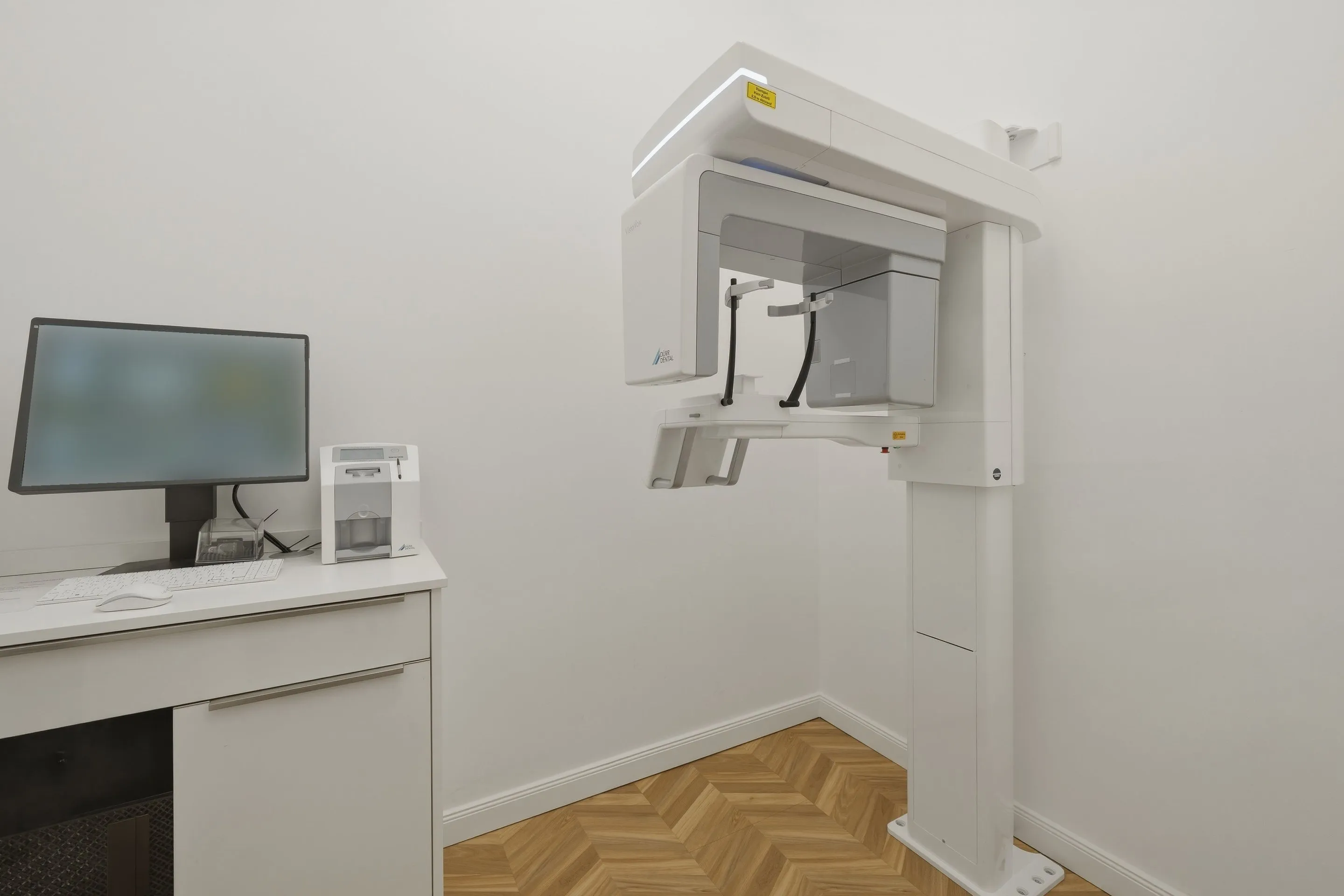
A CBCT scan shows the jaw and nerves in three dimensions, so we can plan implants on the computer in advance. Whether a scan is needed is decided case by case.
- 02
Guided implant surgery
We plan the future crown first, and then the position of the implant to suit it (backward planning). A surgical guide transfers the plan to the mouth.
- 03
Bone grafting
If there is not enough jawbone, it can be built up in many cases. We carry out this procedure here in the practice.
How treatment works. Step by step.
These are the usual steps. What you need depends on our findings, and we will discuss it with you beforehand.
Step 1: Consultation and examination
We examine your teeth, gums and jaw and discuss whether an implant or another type of restoration is an option for you. Any gum disease is treated first.
Step 2: Scan and 3D planning
We scan your teeth digitally and take a CBCT scan if needed. On the computer, we plan the future crown first and, from that, the position of the implant.
Step 3: Placing the implant
A surgical guide transfers the plan to the mouth. The procedure is usually carried out under local anaesthetic. If bone grafting is needed, we do this here in the practice.
Step 4: Healing and new teeth
The implant needs time to fuse with the bone. The new teeth, made by our partner laboratory, are then fitted.
Step 5: Care and check-ups
Implants need thorough cleaning at home as well as regular check-ups and professional cleaning, to help prevent inflammation of the surrounding tissue.
Your questions, briefly answered.
- Does having an implant placed hurt?
- The procedure is usually carried out under local anaesthetic. Afterwards, you may have some swelling or a feeling of pressure for a few days. Beforehand, we will discuss with you how best to look after yourself during this time.
- Titanium or ceramic – what is the difference?
- Both materials are used for artificial tooth roots. Titanium has been in use for decades; ceramic is a metal-free, tooth-coloured alternative. At your consultation, we will discuss which material is suitable for you.
- How long until the new tooth is in place?
- That depends on the findings – for example, whether bone grafting is needed and how the implant heals. You will receive an expected timeline together with your treatment plan.
- Will my health insurance pay?
- For replacement teeth, statutory health insurers pay a fixed subsidy (Festzuschuss) based on the diagnosis, even if you choose an implant. The implant itself is usually paid for privately. You will receive a treatment plan with a cost estimate beforehand.
Send us a message.
Questions about treatment, costs or appointments? Send us a message and we will get back to you as soon as possible.